 Bernadeth Marie
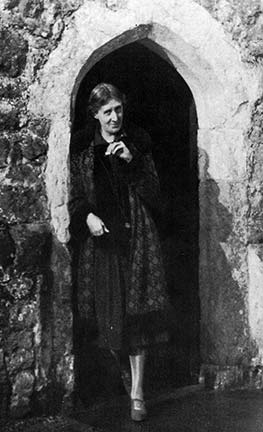
After Virginia Woolf met fellow writer Vita Sackville-West in the early 1920s, the two women began a romantic affair that lasted for a number of years.
Virginia and Vita first met at a dinner party hosted by Virginia’s brother-in-law, Clive Bell, on December 14, 1922.
After learning that Vita was a writer, Virginia invited her to publish a novel with her small press, Hogarth Press. Eventually, their work relationship blossomed into a friendship.
Vita and her husband Harold Nicholson visited the Woolf’s a few months later in February of 1923, after which Virginia wrote in her diary:
“We had a surprise visit from the Nicholson’s. She [Vita Sackville-West] is a pronounced sapphist, & may, thinks Ethel Sands, have an eye on me, old though I am. Nature may have sharpened her faculties. Snob as I am, I trace her passions – 500 years back, & they become romantic to me, like old yellow wine. I fancy the tang is gone.”
Vita was from an aristocratic family, the Sackville-West’s of Sevenoaks in Kent where they lived in their ancestral home called Knole house. Vita and her husband, who were both bisexual and both writers, had an open marriage.

Although Virginia was unimpressed by Vita when they first met, she quickly found herself smitten by Vita’s aristocratic upbringing, her intelligence, her beauty and her family.
They remained friends for a few years before they began their sexual affair in December of 1925, after which Virginia wrote in her diary:
“Vita shines in the grocers shop in Sevenoaks…pink glowing, grape clustered, pearl hung…There is her maturity and full-breastedness: her being so much in full sail on the high tides, where I am coasting down backwaters; her capacity I mean to take the floor in any company, to represent her country, to visit Chatsworth, to control silver, servants, chow dogs; her motherhood…her in short (what I have never been) a real woman.”
Surprisingly, at the time of the affair, Virginia was happily married to Leonard Woolf who knew all about the affair and didn’t object, understanding how important it was for Virginia to be happy. In her diary on November 23, 1926, Virginia described a visit from Vita and Leonard’s reaction to the affair:
“She was sitting on the floor in her red velvet jacket & red striped silk shirt, I knotting her pearls into heaps of great clustered eggs. She had come up to see me – so we go on – a spirited, creditable affair, I think, innocent (spiritually) & all gain, I think, rather a bore for Leonard, but not enough to worry him. The truth is one has room for a good many relationships.”
Virginia’s sister, Vanessa, found out about her sister’s relationship with Vita when Virginia eventually told her about it herself in 1929. The open-minded Bloomsbury member that she was, Vanessa’s reaction to Virginia’s affair with Vita was one of curiosity rather than disapproval.
This affair continued for a few years. When Vita traveled, which she did often, the two would write love letters to each other. In 1926, Virginia wrote the following letter to Vita, who was on a trip to Persia:
“Look here Vita — throw over your man, and we’ll go to Hampton Court and dine on the river together and walk in the garden in the moonlight and come home late and have a bottle of wine and get tipsy, and I’ll tell you all the things I have in my head, millions, myriads — They won’t stir by day, only by dark on the river. Think of that. Throw over your man, I say, and come.”
Virginia was so enamored by Vita that she wrote a novel about her in 1927 titled Orlando, in which the main character is a gender-crossing aristocrat who lives over for over 400 years and has many relationships with both women and men. Vita’s son, Nigel Nicholson, once referred to Orlando as “the longest and most charming love letter in literature.”

Virginia, though, was not Vita’s first lesbian lover and definitely not her last. Virginia often found herself fuming with jealousy over Vita’s other lovers in her life and felt, as the older woman in the relationship, unwanted and dowdy.
The affair eventually ended sometime in 1927 or 1928 but the friendship survived. In August of 1940, when Britain was under attack from Germany and Virginia’s friends were scattered across England, Virginia wrote Vita a letter telling her how much she meant to her:
“I’ve just stopped talking to you. It seems so strange. It’s perfectly peaceful here–they’re playing bowls–I’d just put flowers in your room. And there you sit with the bombs falling around you. What can one say– except that I love you and I’ve got to live through this strange quiet evening thinking of you sitting there alone. Dearest– let me have a line…You have given me such happiness…”
Virginia and Vita remained close friends until Virginia’s death the following year in March of 1941.
Sources:
Court Theater: Virginia Woolf’s Orlando: http://www.courttheatre.org/season/article/virginia_and_vita/
The Virginia Woolf Reader; Virginia Woolf, Mitchell Alexander Leaska
Virginia Woolf: Revaluation and Continuity, a Collection of Essays; Ralph Freedman; 1980
Virginia Woolf’s Women; Vanessa Curtis; 2002
The Private Self: Theory and Practice of Women’s Autobiographical Writings; Shari Benstock; 1988